
Applications and Analysis of Modern Optical Lenses
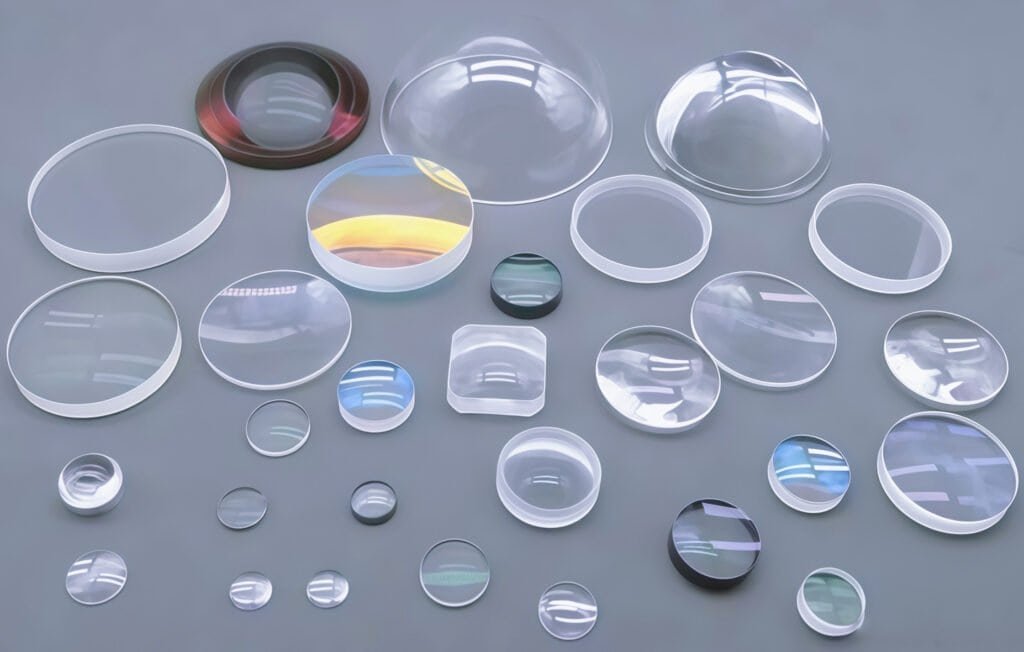
Lenses are manufactured for the purpose of refracting light. Spherical lenses provide rotationally symmetrical refractive power, while cylindrical lenses only have refractive effect in one dimension. Aspheric lenses are an excellent solution for focusing or diverging light in compact spaces, as they can replace multiple spherical elements with a single one.
- Plano convex lenses
Plano convex lenses, characterized by their positive focal length, are frequently used to focus collimated light, collimated point light sources, and reduce the divergence angle of divergent light sources. The design of the lenses allows light to converge effectively after passing through, achieving precise optical effects.
Plano convex lenses are distinguished by their positive focal length design, which incorporates a plane on one side and a convex side on the other. In practical applications, the use of plano-convex lenses, with the convex surface facing the incident light, is recommended in order to reduce the influence of spherical aberration.
- Double convex lenses
The double convex lenses, abbreviated as DCX lens, has two surfaces with curvatures that are both pointing outwards, and thus presents the characteristic of a positive focal length.
The double convex lens is characterized by two key features. Firstly, both surfaces are spherical, typically with the same radius of curvature. Secondly, when the object distance and the image distance are approximately equal, it can significantly reduce aberration. Therefore, its application is to imaging systems where the object distance and the image distance are approximately equal.
- Plano concave lenses(PCV lenses)
Plano concave lenses are a specialized type of lens that has the ability to cause parallel light rays to bend and diverge as they pass through. They also have the characteristics of negative focal length.
Plano concave lenses are frequently used to rectify aberrations generated by other lenses within the system, owing to their distinctive negative spherical aberration properties. They are of great importance in a variety of applications, including image reduction, beam expansion and telescopes.
- Double concave lenses
It consists of two identical concave surfaces and has the characteristic of negative focal length.
Its unique functionality lies in its ability to cause the parallel incident light beam to diverge outward. This type of lens has a negative focal length and is carefully composed of two concave surfaces of equal curvature. In optical applications, biconcave lenses are frequently employed to expand light beams, collimate light rays, project displays, and increase the focal length range of optical systems.
- Meniscus lenses
The meniscus lenses as the name suggests, is shaped like a new moon, with one side protruding outward and the other concave inward. In cases where the curvature of the convex portion of the lens is greater than that of its concave portion, the resulting lens exhibits a positive focal length, a characteristic that frequently makes it a suitable component for magnifying devices. When the concave curvature is greater than the convex curvature, a negative meniscus lens is formed, and its function can be comparable to that of other negative lenses.
The meniscus lens is of great importance in the field of optics. Its unique shape significantly reduces spherical aberration, thereby providing a smaller focus and less aberration, and thus enhancing the imaging quality. When used in conjunction with another lens, the positive meniscus lens is capable of effectively reducing the focal length without substantially introducing spherical aberration. When applying converging collimated light, it is essential to ensure that the convex surface of the lens faces the light source to guarantee the best optical effect.
- Cylindrical lenses
Cylindrical lenses are characterized by their cylindrical surface. In contrast to spherical lenses, its action on incident light is limited to one direction. Cylindrical lenses are frequently used to focus parallel or divergent light beams into a linear shape, and to adjust the aspect ratio of an image.
Cylindrical lenses are composed of two structures: plano-convex and plano-concave, which are used to control the divergence or convergence of light beams, respectively. A plano-convex cylindrical lens is able to focus incident light into a line with a high degree of precision. This type of lens consists of a plane and a convex cylindrical surface. Conversely, a plano-concave cylindrical lens comprises a plano surface and a concave cylindrical surface, with its focal length being negative.
- Aspheric lenses
In contrast to the constant radius of curvature typically seen in spherical lenses, the radius of curvature of aspheric lenses exhibits a continuous variation from the centre to the edge along the principal optical axis. This design allows aspheric lenses to correct spherical aberration and chromatic aberration more effectively, thereby significantly improving the spot quality of the lenses.
Aspheric lenses are used in a variety of professional contexts, including barcode scanning, laser collimation and optical imaging. Aspheric lenses boast a single-element design that, when compared with traditional spherical lenses, significantly reduces the number of lenses in the optical system. This innovative design allows optical component designers to correct aberrations with fewer optical components, enhancing the overall performance of the system.
