
Optical Coating-Core Technologies for Light Control
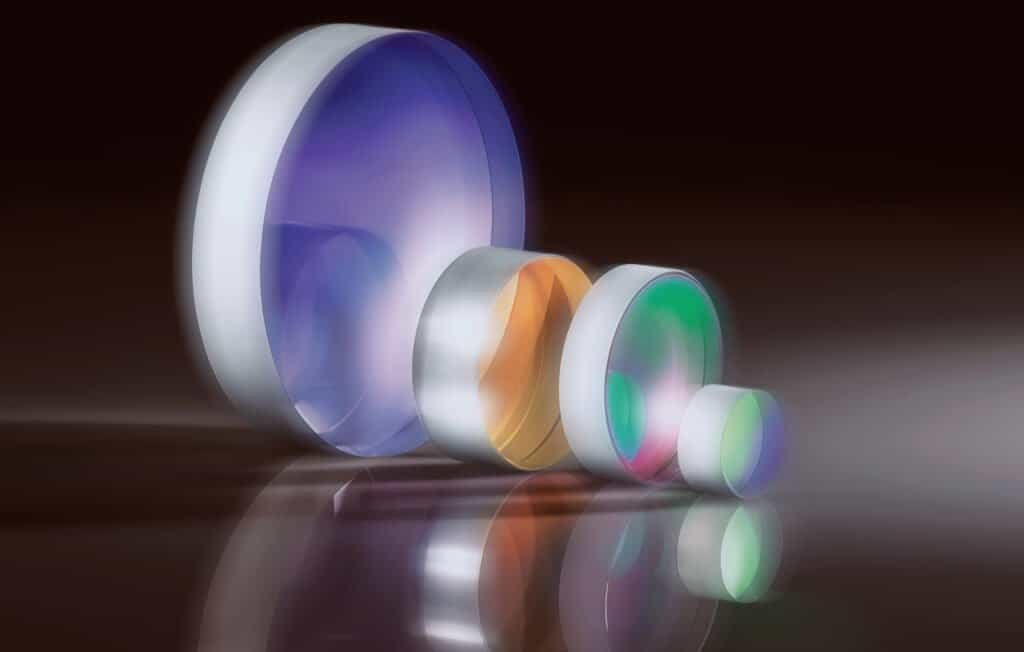
In essence, optical coating is a sophisticated process involving the meticulous application of one or more layers of nanoscale film composed of metals, inorganic media, oxides, and other materials to the surface of various optical components, including lenses, prisms, reflectors, and optical crystals, through physical or chemical methods.
Depending on the specific application scenario and the required optical performance, optical coatings have evolved into dozens of functional types. Each of these coatings is designed to fulfil a particular optical role and meet the unique needs of various fields.
- Anti-reflection coating
This is the most prevalent and extensively utilized type of coating, whose core function is to minimize surface reflection and enhance light transmission. It is also capable of effectively avoiding glare and ghosting, enhancing image clarity and colour reproduction, and making the image more clear and bright.
Single-layer anti-reflection film has a simple structure and relatively low cost, and is primarily used in ordinary glasses and mobile phone screens. Multi-layer anti-reflection coatings offer superior optical performance and can achieve anti-reflection in wider wavelengths. They are widely used in a variety of professional applications, including camera lenses, microscopes, astronomical telescopes, and in-vehicle cameras.
- High-reflecting film
In contrast to anti-reflection film, high-reflection film significantly enhances the light reflectivity through the reciprocal interference of multiple dielectric film, almost achieving lossless reflection.
Metal high-reflection film offers a cost-effective solution with a wide operational wavelengths, primarily used in applications such as ordinary reflectors, rear-view mirrors in vehicles, and stage lighting mirrors. Dielectric high reflectivity film offers a high level of reflectivity and minimal loss, making them a highly effective solution in laser equipment, optical fibre communication, primary sets of astronomical telescopes, LiDAR, and laser medical instruments, ensuring precise and efficient beam transmission.
- Beam splitting film
The beam splitting film can divide an incident light beam into reflected light and transmitted light according to the preset proportion of light energy, achieving the directional distribution of light. The beam splitting ratio can be customized according to requirements, such as 1:1, 3:7, 5:5, transmitting visible light and reflecting infrared light, etc.
Depending on the wavelengths of light it transmits, the film can be classified into three categories: visible light spectroscopic film, infrared spectroscopic film and ultraviolet spectroscopic film. Beam splitting film is widely used in projectors, 3D imaging equipment, laser interferometers, spectrometers and digital camera spectroscopic systems, as a key set for achieving complex optical imaging and light control.
- Filter coating
Filter film is able to screen out light of specific wavelengths with great precision, allowing light of target wavelengths to pass through while blocking other stray and harmful light. It is divided into bandpass filter film, cut-off filter film and dual-color filter film.
Infrared cut-off filter film: It is used in mobile phone and camera lenses, where it filters out infrared light that can interfere with imaging, thereby preventing colour casts and whitening of the picture.
Ultraviolet cut-off filter film: It is utilized in the manufacture of sunglasses, car window glass and protective screens that block ultraviolet rays from damaging the eyes and skin.
Narrowband filter film: It is used for medical testing, environmental monitoring, and fluorescence analysis. This filter film is designed to allow only light of specific wavelengths to pass through, thus enhancing the accuracy of detection.
- Functional protective coating
In addition to the core optical control coating, there are also various composite coatings with protective functions. These coatings optimize light while protecting optical components.
Hydrophobic and oleophobic film: It is used for glasses, mobile phone lenses and camera lenses to form a hydrophobic layer on the surface, making it difficult for water droplets and oil stains to adhere. This film is easy to be wiped and anti-fingerprint.
Abrasion-resistant film: The surface of the glass is coated with an abrasion-resistant film, which enhances its hardness and resistance to scratches and wear. Consequently, the service life of the glass is extended.
Optical coating represents the culmination of human ingenuity in manipulating light and shadow at the microscopic and nanoscale, and is the result of seamless integration of optical science and precision manufacturing technology. Its unassuming appearance belies its precision, which ensures optimal distribution of light according to human needs. This enhances visual clarity and fosters continuous advancements in civilian technology, industrial production and cutting-edge scientific research.
