
What are the key parameters and applications of optical lenses?
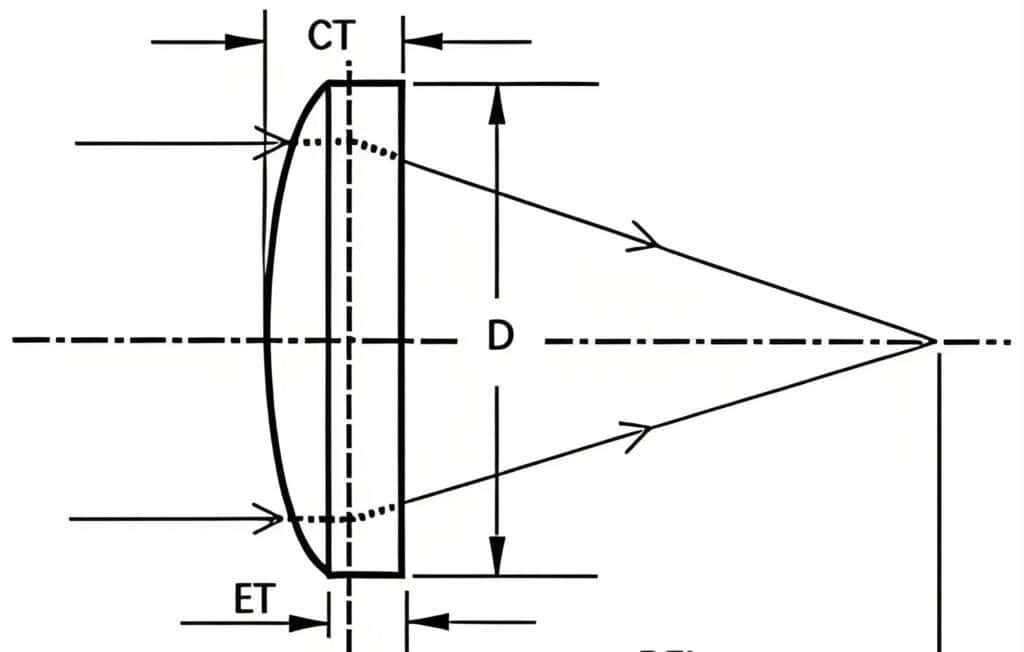
Optical lenses represent a key component in a range of optical instruments, including those used for focusing, imaging, and altering the optical path. These lenses find wide application in fields such as astronomical observation, laser equipment, and medical testing. Its core function is to control the direction of light propagation through the principle of refraction, achieving imaging, focusing or beam shaping. The performance parameters of a lens vary significantly depending on the material, shape and coating process, thus adapting to a wide range of application scenarios.
- Technical principles and core parameters
Optical lenses function on the basis of the law of refraction of light, which states that when light passes through the interface of different media, its propagation direction is deflected. The curved surface design of a lens (e.g. biconvex, plano-convex, concave-convex, etc.) determines its focusing ability, while the refractive index of the material directly affects the accuracy of the optical path adjustment. The materials most frequently used are optical glasses, including K9 glass and quartz glass. The former is known for its high uniformity and low fluorescence properties, while the latter is renowned for its low refractive index and low absorption rate, making it suitable for high-precision optical systems. The key parameters that should be covered include the wavelength range, smoothness, size and thickness, as well as coating type.
- Application scenarios and customized design
The customization ability of the lens represents one of its key technical advantages. For instance, astronomical telescopes require lenses to support a wide range of wavelengths (from visible light to the near-infrared) in order to capture weak signals from distant celestial objects. At the same time, these lenses must be highly smooth in order to reduce light scattering. Laser equipment relies on the shape accuracy of the lens to achieve collimation or focusing of the light beam. In medical endoscopes, the lens must enhance the imaging resolution through miniaturization and special coating. Additionally, advancements in lens technology, exemplified by aspheric design, have enabled the elimination of aberration present in conventional spherical lenses, thereby enhancing imaging quality.
- Material selection and performance differences
Quartz glass and K9 optical glass are two mainstream materials. Quartz glass (such as fused quartz) has an extremely low coefficient of thermal expansion and excellent chemical stability, making it suitable for long-term use in high-temperature or harsh environments. However, its refractive index is relatively low (about 1.46), and special design is required to compensate for the optical path adjustment capability. K9 glass, as a borosilicate glass, has a higher refractive index (about 1.52) and is easy to process into complex curved surfaces. It is often used in scenarios with high requirements for imaging quality.
- Processing technology and quality standards
The manufacturing process of lenses involves a series of precise steps, including grinding, polishing and coating. As the smoothness standard is directly related to light transmittance, it is important to note that a higher smoothness rating results in a lower light loss and clearer image. During the processing stage, it is essential to control the dimensional tolerance at the micrometer level in order to ensure the precise assembly of the lens with other optical components. The coating process is achieved through the use of vacuum deposition technology. Anti-reflection films have been shown to increase the light transmittance of specific wavelengths to over 99%, while reflective films find application in scenarios such as laser resonators.
