

Description

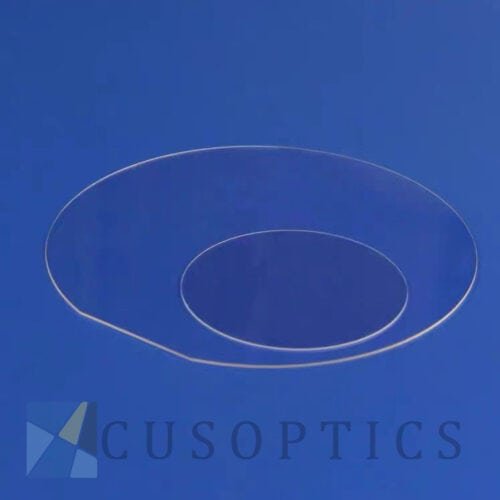
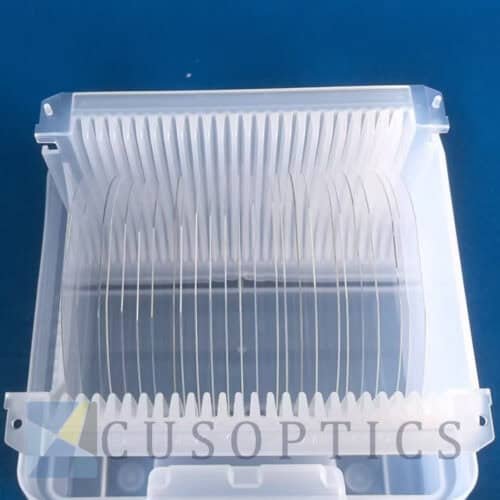
Custom Sapphire Glass
Sapphire glass (synthetic sapphire) is significantly more difficult to process than ordinary glass or plastic materials due to its ultra-high hardness and brittleness. The following is a detailed analysis of its processing difficulties and corresponding solutions:
(1) Cutting process
Difficulties:
Traditional blade wheel cutting can easily lead to edge cracking.
Laser cutting (such as picosecond laser) has low efficiency and the heat affected zone may reduce material strength.
Solution:
Diamond wire cutting: suitable for high-precision linear cutting, with low surface roughness (Ra<0.1 μ m).
Water jet cutting: Cold cutting avoids thermal damage, but requires control of water pressure (>400MPa) and abrasive (diamond sand).
Stealth Dicing: By focusing the laser to form a modified layer inside the material, and then separating it through fragmentation, it is suitable for thin film processing.
(2) Drilling and slotting
Difficulties:
The borehole wall is prone to cracking during drilling (especially for small diameters<1mm).
When the depth to diameter ratio (hole depth/diameter) is greater than 3, the processing difficulty increases dramatically.
Solution:
Ultrasonic assisted machining: reduces tool pressure and lowers the risk of edge breakage through high-frequency vibration.
Laser drilling: Femtosecond laser can reduce the heat affected zone, but the cost is relatively high (suitable for high-precision micro holes).
Chamfering optimization: After drilling, chamfer the hole opening (C-angle or R-angle) to release stress.
(3) Surface polishing
Difficulties:
Mirror polishing (Ra<0.01 μ m) requires long grinding time and low efficiency.
Scratches or subsurface damage are easily introduced during the polishing process.
Solution:
Chemical mechanical polishing (CMP): Combining chemical corrosion and mechanical grinding to achieve nanoscale surface smoothness.
Diamond suspension polishing: using nano diamond particle polishing solution to reduce surface defects.
Segmented polishing: rough polishing → fine polishing → ultra fine polishing is carried out in stages to gradually improve the smoothness.
(4) Alien and curved surface forming
Difficulties:
Hot bending requires high temperatures (>1800 ° C), high equipment costs, and is prone to lattice defects.
The processing yield of complex 3D shapes (such as non spherical surfaces) is low.
Solution:
Hot isostatic pressing (HIP) molding: plastic deformation under high temperature and high pressure, suitable for small batch precision curved surfaces.
CNC precision grinding: using diamond grinding wheels to gradually shape, suitable for small curvature radius irregular parts.
Sacrificial layer technology: Deposition of a temporary support layer on the substrate, removal after processing, to protect fragile structures.
The main characteristics of sapphire glass
The main characteristics of sapphire include high hardness, high scratch resistance, high transparency, high temperature resistance, etc., so it is widely used in many high-end applications.
- Scratch resistance: sapphire glass is made of artificial sapphire crystal, with extremely high hardness, can resist scratches and wear in daily useto maintain the clarity and gloss of the glass surface.
- Transparency and optical performance: sapphire glass crystal has a high degree of transparencyand can transmit more light, so that it has a wide range of applications in the field of observation and display. Transmittance band: 185 ~ 5000nm
- High temperature resistance: the melting point of sapphire glass is 2045°C, and the application temperature is generally below 2000°C.
- Pressure resistance: As a kind of high-strength glass, the compressive strength of sapphire glass at room temperature can reach 2.1GPa, so it is used as a viewing window in deep sea diving.